20 Low-Maintenance Men’s Haircuts for Thinning Hair
Thinning hair is not a styling problem to be hidden; it is a set of constraints to be worked with. The men whose hair looks good through it are almost never the ones fighting hardest to disguise it. They are the ones who adjusted the cut early and stopped asking their hair to do things it cannot.
The three principles behind every cut here
Shorter reads thicker. Length pulls hair flat under its own weight and separates into visible gaps. Short hair stands up, and standing hair casts shadows that read as density.
Contrast is your enemy at the scalp and your friend at the sides. Wispy long strands over bare scalp create the highest possible contrast. Tighter sides against a fuller top creates flattering contrast instead.
Texture beats coverage. Deliberately messy, textured styles break up the eye’s ability to see through to the scalp. Flat, combed, uniform styles do the opposite.
For a receding hairline
1. The textured crop. Short, choppy fringe pushed forward, tight back and sides. Works with a receding hairline rather than pretending it is not happening.
2. The French crop. A blunter, more structured fringe on the same idea. Strong on straight hair.
3. Short textured quiff. Height at the front draws the eye upward. Keep it short enough to hold without heavy product.
4. Ivy League. A grown-out crew cut with enough length to sweep. Tidy, conventional, low effort.
5. Caesar cut. Short horizontal fringe. Genuinely effective for a receding front, and requires almost no styling.
For thinning at the crown
6. Buzz cut with a fade. Removes the contrast entirely. Consistently the highest-impact option and the least maintenance of any cut on this list.
7. Crew cut. Slightly more length on top than a buzz, tapered sides. A safe default.
8. Butch cut. Uniform short length all over. No contrast anywhere, nothing to give the crown away.
9. Textured brush-up. Length brushed back and upward, which lifts hair off the crown instead of laying it flat across the thin patch.
10. High and tight. Very short sides with a small amount of length on top. Military in origin, and effective for the same reason.
For diffuse thinning all over
11. Short messy layers. Layering creates separation and movement, both of which read as volume.
12. Textured side part. A soft, deliberately imprecise part. Avoid a hard comb line — sharp partings expose scalp.
13. Short pompadour. Volume concentrated at the front, kept modest so it holds.
14. Faux hawk. Everything angled toward the centre. Concentrates what you have where it shows.
15. Messy fringe. Forward and slightly tousled, softening the entire hairline.
Five that suit advanced thinning
16. Clean shave. 17. Shaved head with a full beard — the beard restores facial framing and balance. 18. Skin fade into short top. 19. Horseshoe with tight sides, worn deliberately rather than disguised. 20. Buzz cut with stubble beard, matching lengths for a coherent line.
What to actually say to your barber
Be direct: say your hair is thinning at the crown or receding at the temples, and ask what they would recommend. A good barber will have cut hundreds of heads like yours and will tell you honestly what holds and what does not.
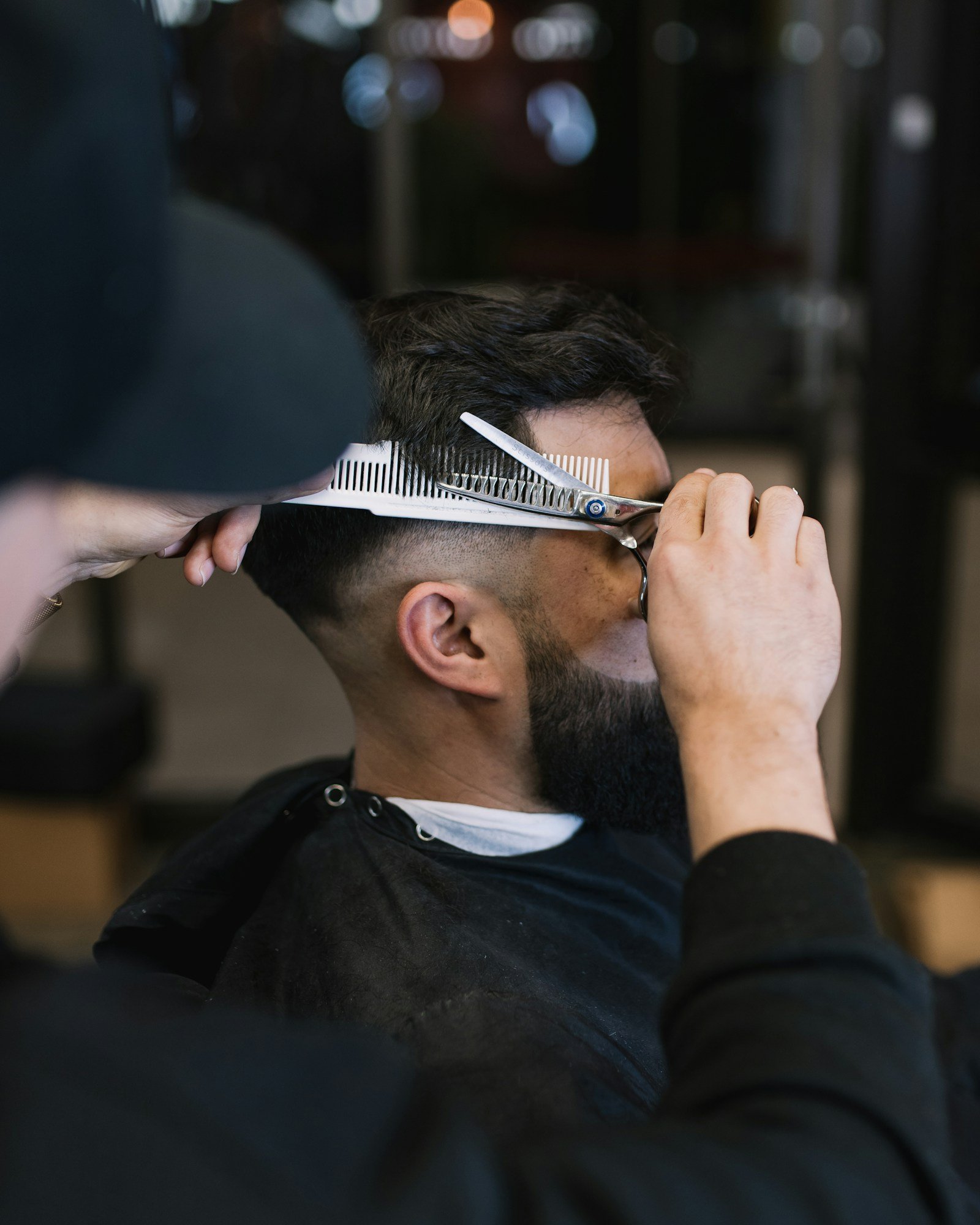
Ask for point cutting rather than blunt cutting — it creates softer, more textured ends. Go shorter than feels comfortable the first time; almost everyone is glad they did. And book more frequently, every three to four weeks, because short cuts stop working as soon as they grow out.
Three habits worth more than the cut
Use matte products only — clay, paste, powder. Anything shiny clumps thin hair into separated strands and makes scalp more visible, which is precisely the wrong outcome.
Blow dry on cool, lifting at the roots with your fingers. It takes ninety seconds and does more for apparent volume than any product.
And if the thinning is recent and progressing, see a doctor sooner rather than later. Treatments for pattern hair loss work considerably better at preserving what you still have than at recovering what has already gone.